Fertilizer is one of the biggest checks you write every season.
Most of it goes in the ground.
Not all of it goes where the crop can use it.
That gap is where the right fertilizer applicator earns its keep.
Choosing between liquid and dry fertilizer isn't about which one is better. Both work. The real question is which one fits your crops, your equipment, and the way you already farm, and how precisely you can place it once you've decided.
This guide breaks down how liquid and dry applicators differ, where each one makes the most sense, and what to look for before you add one to your operation.
What a Fertilizer Applicator Does
A fertilizer applicator meters and places fertilizer in or on the soil. The simplest systems broadcast product across the whole field. More precise systems place it in a band near the row, where young roots can reach it.
That difference matters. Fertilizer spread between rows feeds weeds and open ground as much as it feeds your crop. Fertilizer placed near the row puts nutrients where the plant can actually use them.
Why Broadcasting Everything Falls Short
Broadcasting is fast and familiar, and for some jobs it's the right call. But when it's the only tool you have, you pay for it in a few ways.
More product for the same result. Spreading fertilizer across the whole surface means applying enough to cover ground the crop will never reach.
Less control over timing. A single broadcast pass can't always deliver nutrients when the crop needs them most.
More loss. Surface-applied product is more exposed to runoff and other losses before the crop takes it up.
A dedicated applicator, dry or liquid, gives you more control over where and when your fertilizer goes.
How Dry Fertilizer Applicators Work
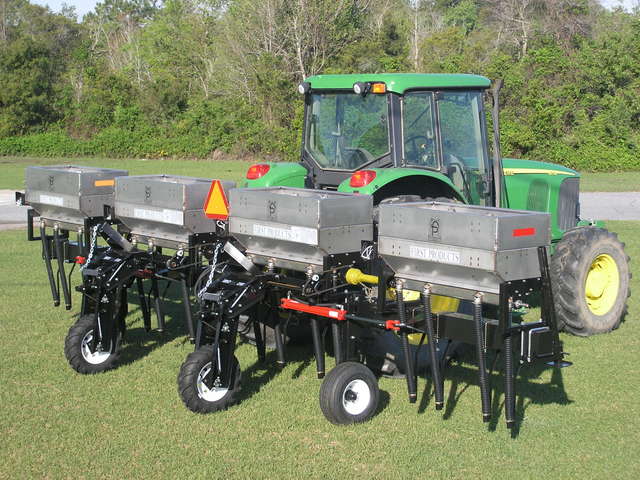
Dry applicators meter granular fertilizer from a hopper and deliver it through outlets to the soil, often banding it in the row.
Where they fit. Dry systems work well for row crops, orchards, vineyards, tree crops, and small-acre growers like vegetable operations and food plotters. Granular product stores easily and is often simple to buy in bulk.
How 1st Products builds them. 1st Products dry fertilizer applicators band fertilizer in crop rows while metering granular material. They mount to cultivators and tool bars, including Pittsburgh frames, diamond tool bars, flat tool bars, 3-point hitch frames, and side dress frames. The lineup ranges from the Economy Series with stainless steel hoppers for smaller operations, to the Standard Series with 2, 4, 6, 8, and 12-row tool bar options, to a dedicated Orchard Applicator for tree and vine rows.
Ground or electric drive. Ground drive systems meter off wheel speed. Electric drive systems offer a wider range of application rates for operations that need more flexibility.
How Liquid Fertilizer Applicators Work
Liquid applicators deliver fertilizer through tubes and openers, placing it precisely relative to the seed row, often at planting.
Where they fit. Liquid systems are a strong fit for row crop growers who want starter fertilizer placed close to the seed, where it's available to young plants early in the season.
How 1st Products builds them. 1st Products liquid fertilizer openers are built for precise starter placement. The front-mounted double disc opener attaches to John Deere, Monosem, and Case IH planters with no drilling and places fertilizer 2 inches beside and 2 inches below the seed, the placement often called 2x2. A rear-mounted opener for John Deere row units places starter fertilizer on both sides of the row, and a round shank double disc opener mounts to rolling cultivators, Pittsburgh, S-tine cultivators, and diamond bar setups. Depth adjusts from 1 to 3 1/2 inches, with stainless steel tubing and couplings.
Liquid vs. Dry at a Glance
Dry fertilizer. Granular product that stores easily and suits banding in the row across row crops, orchards, and small acreage. A good fit when you want a steady nutrient base and simple handling.
Liquid fertilizer. Precise placement near the seed at planting, with nutrients available to young plants early. A good fit when starter fertilizer is part of your plan and you're already running a planter.
Both. Many growers use both: dry fertilizer to build the base, and liquid starter at planting for an early boost. The two systems work together more often than they compete.
What to Look for Before You Buy
What are you planting, and how?
Row crops at planting point toward liquid starter systems. Orchards, vineyards, and cultivated row crops often point toward dry banding.
What will it mount to?
Match the applicator to the planter, cultivator, or tool bar you already run so it fits your operation without a major overhaul.
How precise is the placement?
The closer you can put fertilizer to where roots will be, the more of it the crop can use.
Is it built to last?
Fertilizer is corrosive. Look for stainless steel where it counts, like hoppers, tubing, and couplings.
Put Your Fertilizer Where It Counts
The best fertilizer applicator is the one that fits how you farm and puts nutrients where your crop can use them.
The off-season is the right time to set that up, before planters and cultivators head back to the field.
Explore 1st Products dry fertilizer applicators and liquid fertilizer openers, or contact the 1st Products team to find the right setup for your equipment.